Episode Transcript
[00:00:00] Jesse: Foreign.
To the Empowered to Connect podcast, where we come together to discuss a healing centered approach to engagement and well being for ourselves, our families and our communities.
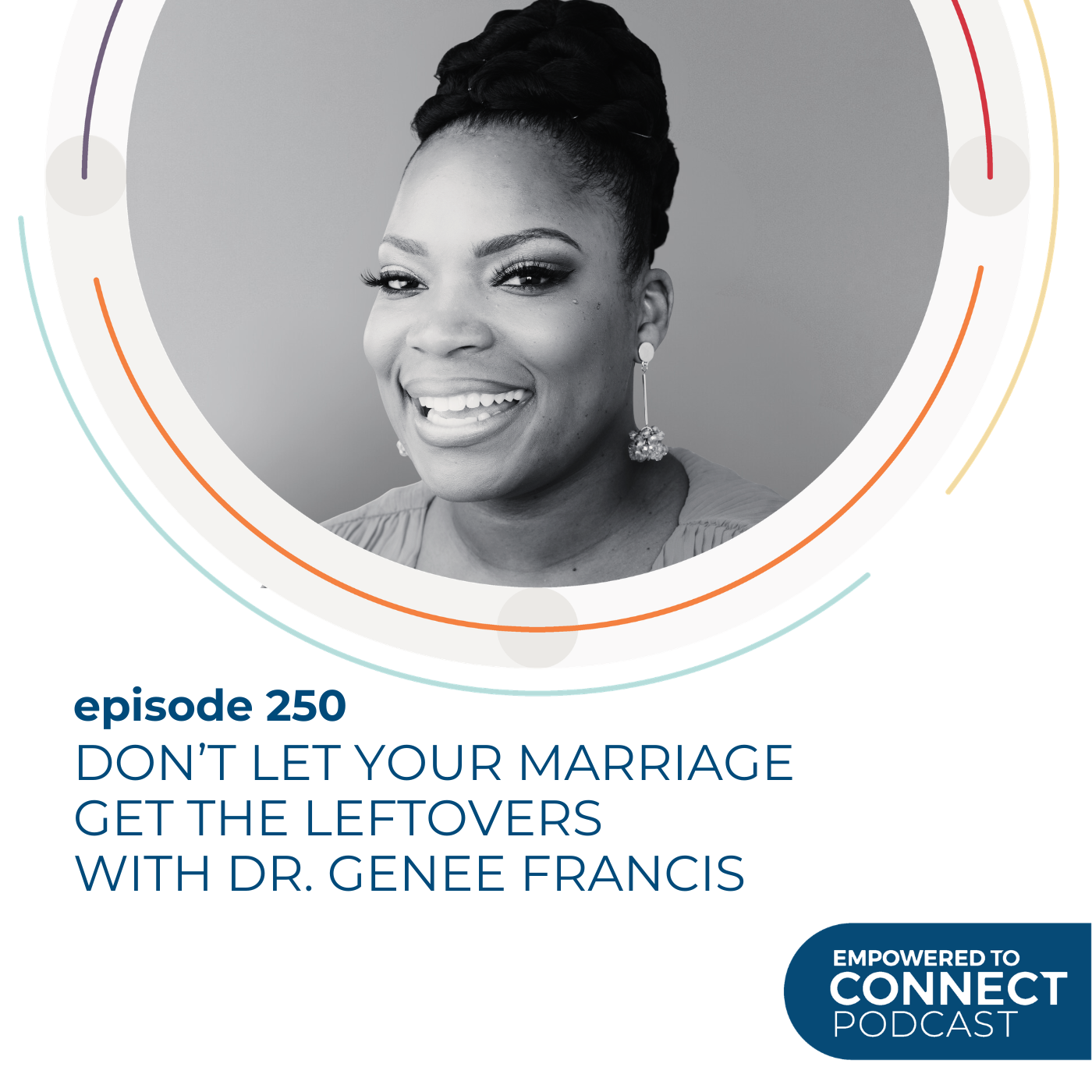
Hey, everyone. I'm here with Genee Francis. I'm so excited to welcome her to the podcast. Genee, why don't you tell us a little bit about yourself and what you do.
[00:00:27] Genee: Absolutely.
Well, thank you so much for having me, Jesse. It is a pleasure to be with you. Today.
I get the privilege of serving individuals and families and marriages as a licensed therapist, and so I wear several different hats. I have the ability to serve in private practice and work with individuals and families and couples in that space. And then I also serve with Windshape Marriage. And Windshape is a beautiful organization. And in that space, I get to open oversee our retreats, our enrichment retreats, and also just work with our content and our programming team.
[00:01:07] Jesse: That's so great. And some of our listeners may be familiar with Windshape, and they do such a wonderful job of supporting people in their retreats.
[00:01:16] Genee: Yes.
[00:01:17] Jesse: Well, tell me a little bit. What drew you into kind of this work with marriage and family, and how did you end up focusing on marriage training with Windshape?
[00:01:27] Genee: Yes, Well, I will say that my interest in this space began as a child, and I just had this curiosity around this topic of marriage personally. My parents divorced at a very young age, but I found myself watching different couples, and I was always curious about why do some marriages thrive and why do some fall apart? Right. So that literally was like, this question that I had as a child. And so as I got older, I began to kind of work in education and decided at that point that I would go back and specialize in this area. And so that is how we started.
[00:02:07] Jesse: I love that. And I think we probably all resonate with that question.
I'm wondering even, did you. Did you get answers to your question?
[00:02:19] Genee: Yeah, I don't know if I have answers, but I definitely have some theories. Right. I have some theories about the different types of marriage and really the foundation of marriage and then some of the work of marriage that it takes in order to sustain over time. So
[00:02:35] Jesse: I share your interest in just kind of the, the.
The interest in what makes humans the way they are and then the way that they relate with each other. I have a human development and family studies background, so.
[00:02:49] Genee: Okay.
[00:02:50] Jesse: Similarly, being like, what makes people act the way they do or. Or relate the way they do, all of that human psychology was really fascinating to me.
[00:02:59] Genee: Yes, absolutely. I was a psychology major for that same reason.
[00:03:04] Jesse: Fantastic.
Well, when you know, if you're wearing your either hat that you have in your professional space, what would you say are the most common sources of marital strain, particularly within that foster and adoption care world when you're seeing couples come to you?
[00:03:24] Genee: Yeah, I think the first thing I would probably have three immediate answers that come to mind. But the first thing I would say is just a lack of time.
One of the things that especially parents overall, but especially adoptive and foster care parents, because of the complexities that they are handling and really kind of holding there, oftentimes is a lack of time to nurture the marriage.
And so oftentimes the marriage gets the leftovers. You know, what's left? And so where we may have been prioritizing our time together or our date nights or different ways that we connect, sometimes you just don't have a whole lot left in the tank for that.
So that would be the number one thing, of course, that leads to disconnection.
And sometimes you can disconnect because of time, but then you can also disconnect just from making, you know, the role of parent basically your whole world. And so being very, very careful about that piece.
And I'd say the third thing that I would say is just sometimes when we're parenting children, especially children from hard places, you can have differences in how you see things and how you desire to parent. And oftentimes that can build some division or resentment if we aren't careful to manage some of those differences.
I would say that would be the third common source.
[00:04:49] Jesse: You have boiled that down really succinctly. I think I would agree. I've seen those three things.
My husband and I just celebrated 20 years of marriage back in the spring. And I can definitely see how those things can take root and really start to just grow in a marriage and kind of create some chaos and problems and the marital strain that we're talking about, even when you talk about lack of time and the marriage getting the leftovers, the mental picture that came to mind is myself as a stay at home mom eating the crust off of the plates, you know, and that would be my lunch. It's like everything gets leftovers.
Your entire life feels like leftovers. To sometimes the way that caregiving can totally consume you and take over.
[00:05:43] Genee: Absolutely.
[00:05:45] Jesse: And I think especially with when we're talking about adding to our family or, or building a family in ways that include layers of adoption and foster care, there's going to be some really specific griefs that are included. And so I'm wondering what the role of grief plays in some of that strain, or when you see people coming to you, you know, that grief could be over maybe a road of infertility that they've walked together.
[00:06:17] Genee: That's right.
[00:06:19] Jesse: Or over the story that they have now, you know, that has entered their family through their child, that that child has an entire history and story that is ongoing and is becoming a part of that family's story.
So how do you feel like that shows up and how it gets processed in terms of a marriage together?
[00:06:43] Genee: Yeah. No, grief is real. Let me just start by saying that, you know, it is so real when you begin talking about the fost and the adoptive journey for everything that you just named. Because oftentimes it follows something that happens, some disappointment.
It could also be just some of the grief that happens in that waiting. You know, there's always this waiting process, whether you're waiting, right, to conceive, or you're waiting for your foster child, or you're waiting for the adoption process to kind of take its course. And so there's a lot of grief that happens.
And I think sometimes, you know, all of us as children have these dreams, and then we become adults and we have other dreams. And sometimes when you. When you know that you are not going to be able to fulfill that dream and maybe the way that you thought your family would manifest, there's grief over that. So, yes, I can be excited that I'm walking into this process to be an adoptive or a foster mother, but I also am grieving the fact that I'm not able to have my own children biologically. And I think both can be true and can be a thread that's running through.
And then the other thing you mentioned is the grief that sometimes we're grieving for the child in our care, for what they lost and what they're not able to have because they aren't with their biological family.
And so I think you have to work on making sure that you are in a place of health and that mentally and emotionally you have done some of the work to take care of yourself, because it's easy to really get stuck if you're not careful.
[00:08:25] Jesse: I like how you frame even just using the word dreams, because I think it's natural for all of us to have dreams. And you're right, we have them starting from a very young age, and they evolve and change, and some of them stay the same, but some of those dreams start becoming expectations.
And I think that then is so sneaky because we end up feeling like we're entitled to those things.
Or that they should be reality. And when they're not matching reality, it's hard to realize those were dreams I had.
That expectation is now not matching my reality. So maybe for someone that's really identifying and resonating with what you're saying there, what would the first step to kind of resolving that grief, moving through that grief be? Do you have any advice for them?
[00:09:27] Genee: I think the first thing is acknowledging that you've got these feelings, acknowledging that you have these unmet expectations, acknowledging any anger or frustration or resentment that has set in.
And sometimes that's a big task for people to walk through on their own. And so I think it's so important to also just advocate for, you know, therapy and going and getting help in this way, because we want to be as healthy and whole as we can when we walk into our journey as foster or adoptive parents. And so this is some of that pre work that I think is absolutely necessary because again, grief is real and if we don't figure out a way to contain it, then we will not be our healthiest, best self.
[00:10:19] Jesse: It is difficult to kind of reconcile the fact that we feel the way we feel, especially when we maybe associate some of those feelings with guilt or we feel shame about them.
But that honesty, I mean, I know I've personally found that meeting with a safe person, a therapist, a counselor that, that I can trust. And I don't feel like I have to say the right quote, unquote, the right thing in front of them, that they will accept whatever I say. And I can say those scary things to me out loud.
That's so powerful to get that out of my mind and heart and just into my reality so I can start dealing with them.
[00:11:04] Genee: Sure, sure. And Jesse, what you also have to realize is that oftentimes you've got these feelings and these thoughts and these unmet expect.
But people sometimes aren't able to grab them and name them. They just know that they're feeling something.
[00:11:16] Jesse: Yes.
[00:11:17] Genee: And there's something there. And I don't know why I'm showing up the way I'm showing up. And so again, having someone that is safe, that you can process and be just completely vulnerable with is so key,
[00:11:28] Jesse: especially with the lane that you're running in. I'm thinking, are you seeing this happen sometimes with individuals, but it's having a hard time kind of coming together in a marriage. Maybe one person's processing and the other is resisting or they're having trouble processing together. What would be the. What would be your advice for someone who's like, I feel like I've got a good handle on this, but I know my partner is struggling.
[00:11:53] Genee: Sure. Yes. Because more often than not, you're not in the same place. We're two different people, two different backgrounds, two different hearts, two different dreams. And so oftentimes what you find is that people are in two different places. And so, yes, being able to acknowledge that difference and then supporting one another through the process of trying to heal is so important because, yeah, that. That's a real thing in marriage and can be one of those devastating factors.
[00:12:21] Jesse: Do you have advice for what to look for? If someone's trying to look for a good counselor or therapist, especially if they're looking for, looking together for a marriage and family therapist, I feel like it's so hard to find a good therapist on your own. I can't. I mean, I just think, especially if you bring two people with two opinions and different personalities are hitting them different ways, what should someone be looking for? What should a couple be looking for when they're looking for a good therapist?
[00:12:49] Genee: You know, it's so hard because therapy is all about the fit. And so I would say you definitely want to try to find the perfect fit. And then finding the fit for a couple is even more tricky.
But what I would say, especially if I'm really focusing in on adoptive and foster families and whatever, whatever our goal is, whatever our shared goal is, I believe that therapists should specialize in that space.
So how to go about finding is I would first narrow down my search to people who specialize in, you could say, adoptive and foster care.
Or if my issue is we're having a hard time attaching. Right. Then I would find someone who specializes in attachment. But I would say that would be my first. I'm a business. But because foster and adoption is so niche, and it's one of those experiences that unless you have experienced it or walk very closely alongside someone who's in that journey, you don't know the complexities of it. And again, it's easy to kind of romanticize what that will look like. But the reality of that is normally not quite what we're expecting. So the other thing I would recommend in trying to find a therapist is if you have other families or other couples that you know that have successfully been in a. In a clinical, therapeutic relationship with somebody, ask for some referrals and some recommendations.
I would also say that I would ask for referrals and recommendations, maybe from a counselor that I've used that I trust and say, I know this May not be your specialty, but is there anybody else? Because I think many times people will refer but not understand that it's really important that the person who's walking alongside you really understands and specializes in that space.
[00:14:37] Jesse: Yeah, that's great advice.
I know I'm throwing you a bunch of questions that I hadn't told you I was going to ask, but you're doing a great job answering them. I'm just a lady full of questions.
[00:14:48] Genee: I love it.
[00:14:49] Jesse: I do have another one, which is, you know, especially as you wear both these hats that you get to kind of work on what's happening over at Windshape and you get to.
You get to experience that therapeutic setting. Would you recommend if a couple is struggling or having some differences or feeling disconnection, which thread should they pull on first? Should they maybe pursue a retreat type setting to reconnect, or should they go visit a therapist or a counselor together first?
[00:15:23] Genee: Yeah, you know, I think it would depend on the nature. Right. So are we in crisis or do we just need some tools?
[00:15:31] Jesse: Right, Good questions.
[00:15:33] Genee: Right. Do we need a break and some rest, or are we at each other's throats?
So I think you have to gauge where are we truly being real with yourselves as a couple and saying, what is it that we need? And so if we are in a state of crisis, we're not getting along, we feel very disconnected, then I would say I would go towards seeking a counselor, a coach, maybe even beginning with a trusted pastor or someone.
If we are just needing some space and time to just settle, if we are thinking that we want some new tools. The other amazing thing about Windshape and retreat settings, specifically, we've got a retreat that's called Woven. And Woven is only for foster and adoptive parents. And so you're able to go and you're in community with people who understand your journey and who get it.
And so I would highly recommend that even if you're in crisis, because that could also be such a really rich blessing to be in a space.
The most beautiful thing about the Woven Retreat is the community and the fellowship amongst all the different couples that attend.
[00:16:42] Jesse: That's great. I wanted you to be able to brag a little bit and spotlight some of what winshape offers. That's wonderful.
All right, let's rewind. Let's say a couple is interested in adoption of foster care. And know some of you are listening to this podcast and you're just trying to kind of dip your toes in and get your feet wet and try and figure out like, what's this all involve?
What would you say for two couples that are interested in kind of getting started, is there anything that they could or should be doing in their marriage before that placement even happens? Maybe they're waiting or maybe they're even just still doing paperwork.
[00:17:20] Genee: Yeah, absolutely. There are some things that I think you should do before you even initiate the process.
[00:17:26] Jesse: Okay.
[00:17:26] Genee: Right.
But I would say top of the line is align on their why.
Why or why are we doing this? What is our core motivation? Right.
Jason Johnson is someone that I deeply respect that is one of the experts in this space.
He works for CAFO and he has this quote that he says that I just love. But what he says is foster care is less about getting a child for your family and more about giving your family for a child.
And so I just think that when you are in the process of really kind of having early discussions and really thinking that, you know, or really considering the journey, I think aligning on your why and really coming together to say, why are we wanting to do this? What is motivating this is so important for a marriage.
[00:18:20] Jesse: Absolutely. And I can see how that's going to connect Janee to those dreams and expectations. Right. We may not even realize that those are sitting in us or that. Or that they're different in our spouse or partner. And so to talk about that, to talk about our why is going to kind of uncover some dreams or expectations we may have.
[00:18:43] Genee: Absolutely, absolutely.
[00:18:44] Jesse: For our family, for our child, of each other.
Yeah,
[00:18:48] Genee: yeah, yeah. One of the other things I highly recommend is to educate yourselves. Right. Educate yourselves on.
And you can do that in so many different ways. But what I would say is there are trainings that you can begin to kind of dip your toe in along the topic of trauma.
I think most children that you foster especially have been through some experiences that have resulted in trauma. And so making sure that you understand what that means and what that looks like is so key.
I would say interviewing other families that are already in the work, that are already serving as foster or adoptive parents is wise.
And then here's one that's even deeper. Serve as relief for families that are already in the work. And so serving as relief would look like, you know, babysitting so they can get a night out or, you know, just being available to help care for their children if they need to run errands or go to work or something like that. But that hands on experience will let you know quickly whether you are really, really wanting to go through the journey.
[00:20:00] Jesse: That's great. Advice I'm thinking about, let's say, a couple either before they've received their first placement or even they're now into this journey. They're discovering the reality that they don't have as much time for each other as they used to. And they see that they are kind of in that pattern of giving each other their leftovers.
What does it look like to protect time for each other? Do you have advice for us about that?
[00:20:30] Genee: I do, I do. I think one of the things that helps is your community.
Right. Your care team. And so the first thing I would say is making sure that you have identified your community and your care team that's going to make it possible for you to be able to protect your marriage.
Some of the things that I think once you have a care team in place, I think you have to prioritize your time with your spouse.
And I think prioritizing it looks different in that season because where we may have just been able to easily schedule our date nights or our coffee dates with one another, it becomes a little bit layered and tricky with any parent. Right. But especially a parent who has a child with complex needs.
So I would say prioritizing it and then protecting it. So making it known so that the kids know, like, this is something that is very precious and very special.
But protecting it also by once we have committed to it, then working together as a couple to figure out how are we going to make this happen and what supports do we need so that we can make sure that this happens.
Let me throw something else in there, too, because I think when we think of our time together, sometimes we have to realize that in the season we may have to think a little differently about it. So whereas date night used to be a thing, we may need to grab coffee while the kids are all at school. Right.
We may need to get up a little few minutes early so that we can have devotion together or just have some talk time together, because it's not gonna happen if we let the day get started.
So I think you also have to be flexible.
Right. And move with the season.
[00:22:10] Jesse: Yeah, I identify with that. Even just. I'm thinking about when our two daughters were really young. Nick and I would try and meet up during one of his lunch breaks. And I would have the girls with me, and I would just. Just being in his presence, he was my safe person. So I just immediately deflated. It was like, the other parents here, my safe guys here, like, I have nothing to give you at this lunch. Like, please just help me feed our children together. It was not. We thought we were being smart, like, ooh, a day date. It was like, like, no, this is not. This is not.
We can't give each other our best during this time period.
And now fast forward. We have a 16 year old and a 12 year old right now in our marriage. And it's our time that we've carved out for each other historically has been in the evenings. Well, guess what? Teenagers don't respect your evenings.
That is when they have come alive. So we often find ourselves trying to have a conversation and the 16 year old coming down and interrupting all the time and wanting to ask questions. And it's like, okay, we are going to have to figure out a different time period because this is maybe changing in this current season.
It just feels like so much adjustment no matter what stage your kids are in.
[00:23:35] Genee: That's right. That's right. We've definitely got to be flexible.
[00:23:38] Jesse: Yeah.
Well, even as you're talking about kind of protecting those things, what are some warning signs that maybe we could be thinking about as we're just observing them and thinking about the health of our relationships?
[00:23:55] Genee: Yeah.
The first thing is when you start to feel more like roommates, you know, and so you are experiencing relational and emotional distance and all of a sudden you feel like, okay, I don't really know what I thought I knew about my spouse or I don't really know what's going on. What's the latest and the greatest.
So I've got data, but it's old, it's not current. Right.
You're no longer in sync when you are just kind of flowing and you are feeling like, oh gosh, we're not agreeing on anything. We are falling on top of each other. When it comes to not understanding the schedule and who's picking up and all the things, we're not really flowing well together.
And then the other thing I would mention that is a good warning sign is that you're getting short with one another and not really having the grace or your rope is very, very short and you find that you're a little bit irritable with your spouse.
[00:24:55] Jesse: That's good. And when we are noticing those signs, is that when we hightail it to the therapist or there's. Are there some like things we can do before we get to that point? What, what are your recommendations there?
[00:25:09] Genee: Yeah, I think the first thing is the name it with your spouse and just say, hey, I'm feeling disconnected. Right. Because sometimes it may be just a thing that, you know, we just need to acknowledge and we Just need to realign on. So it's not always time to run to the therapist, but sometime we can, like, let's just talk about it. Like, are you feeling like I'm feeling? Is this just me? Am I needing something that you know? So I think just some good conversation around it is the first thing that I recommend.
[00:25:39] Jesse: Yeah.
I'm even just thinking, I wish I had Nick co hosting this with me today because I'm like, he would have a whole nother side of it that I think would be really helpful to listen in on. But in his absence, I'll share. I think just living this out over a couple of decades, I think our own experience has been like, sometimes something's going on with one of us that the other just doesn't have a window into. It's not personal about the other person. It's just maybe one of us is struggling. And to be able to kind of talk about that with each other, it has been difficult at times. Sometimes it's hard to talk about what you're going through or to name it, as you mentioned, or it's hard to know how you need support.
But I think being able to kind of get on the same page has always been so important for us.
Speaking of which, let's talk about when your parenting styles differ and what advice you might have for parents that are like, oh, I think it should be this way, or, you know, he's very heavy handed, or she's not providing enough structure, or I'm not,
[00:26:51] Genee: you
[00:26:51] Jesse: know, it could be the other way around when we're talking that out and maybe we have a difference of opinion. Do you have any strategies we can be thinking about as we kind of try and collaborate and reach an agreement?
[00:27:04] Genee: Yeah, you know, this is. This is like a loaded question for me because there's so many different directions I can go.
[00:27:09] Jesse: That's true.
[00:27:10] Genee: Keep me focused and you remind me where we're supposed to be going if I get off track. But what I will say, first of all is, you know, we've got a difference of opinion. And I think the first thing for couples especially is to understand that it's a difference, but there's not a right or a wrong, you know, and because I think sometimes with differences, we start fighting for right and we're trying to prove the other one wrong. And it's like, okay, it's not that.
And so one of the best things to do to combat that is to come together first. And what is our goal in all of this?
What is our goal? Do we have a shared goal. Normally we do.
So then if we've got this shared goal, what is the best way for us to partner? Well, to lead to that goal. Right. And so partnering well, and I'm going to specify with adoptive and foster children, right. Oftentimes it's not about structure and rules, because really, the key to it all is attachment. And so one of the first things you want to do is you want to look at it through your trauma brain, right. And through your attachment lens. And so to me, sometimes that takes out of the my way versus your way, because we've got this attachment way.
So what is the best way for us to get to the goal, keeping in mind what this child or this circumstance calls for?
So I think it's not an easy answer, but I think that strategy helps people to get on the right page, the same page together, to be able to move towards the goal, accomplishment.
[00:28:42] Jesse: I love that. For two reasons, Janae. The first is we talk about at etc. When we are experiencing maybe difficulties in a relationship or with behavior with a child, we're not going to put the child versus us. We're going to, you know, stand side by side with that child, and it's us versus the problem or us versus the issue. And I like how you're basically drawing that into adult relationships, too. Yes. You probably have a common goal, even though you disagree on how to reach it or have a difference of opinion. And so I love it. Just sets you up on the best collaborative path to be able to start making negotiations. And I truly, we use these skills with our teenagers now, you know, because the more. The older they get, the more autonomy they have.
There's some negotiations that get to take place. And so I'm thinking about the early years of our marriage.
We got a lot of practice before we had to do that with a third partner, which was a teenage girl.
The other thing that's coming up for me is you're talking about your opinion, their opinion.
But when we are thinking about our child, we might have to actually choose a third way that doesn't have to do with either of our opinions. And so if you're listening to this and you're like, man, yeah, I wish I had a way to look at that. Empowered to connect, has resources on that third way. In fact, that is something that Nick and I very early in our parenting and early in our marriage were exposed to. That I think we would both say has been transformative for us as individuals and into our marriage because it really had us thinking hard about our Own histories, our own selves, what we needed as individuals, what we needed as a couple, our expectations as parents. And being able to get on that same page in our marriage as we parented our children has been such a gift. So, yeah. And I hear maybe a woven retreat at Windshape might also be another great type of resource. If you're like, hey, let's get around some other couples and kind of talk about what values do we share and how do we get on the same page with that. That.
[00:31:20] Genee: Yes,
[00:31:22] Jesse: that's great.
Maybe I. I kind of want to talk about the other side of the coin. Maybe you're listening to this and that you've walked through some really hard seasons. Maybe you're in a hard season or you've. You're emerging from one. I'm wondering if you have any, any advice or encouragement for couples that are sticking in it and they're. And they're doing some hard work together, but it is difficult.
Do you have any encouragement for someone like that that's listening?
[00:31:54] Genee: Absolutely. My first encouragement is the marriage relationship is worth it.
And so just being willing and really committing to doing the work and really working, like on how do we prioritize this marriage? How do we protect it?
And one of the things, especially concerning adoptive and foster care parents is you gotta allow other people around inside of it. You've got to allow other people to help. Because sometimes our own attachment needs or our trauma history keeps us from wanting to share and spread the load. Right. But we have to know that in order for us to be able to really nurture and protect our marriages, we have to have a village and allow the village to serve.
[00:32:38] Jesse: What.
Let's pull that apart just a little bit. What does it look like? Maybe. Could you give us some examples of what it looks like to let someone into that?
Because I can imagine and have experienced. It gets pretty messy. It gets pretty messy sometimes. Right?
You've got your stuff and your partner has their stuff and your kid has their stuff. And when that's all mixing together in a family, it's hard to let someone in on that. So what might that look like?
[00:33:09] Genee: Well, in terms of managing the load, I would say just making sure that you've got the care team that your child needs.
And so that care team could look like respite care or relief parents that help and again, provide care so that you can care for your marriage and can take a break and go on a date or have a weekend getaway or such.
The other thing is making sure that you've Got, you know, any kind of therapy or any kind of supports that that child needs in place because that's going to help keep everything kind of settled as well.
I would say letting people in is identifying ahead of time is who the people are that you can talk to.
Because sometimes, again, you can feel very isolated as a foster parent or even as an adoptive parent. And so having other people, having couples that you can talk to, that can help normalize situations for you and encourage you and let you know, like, this is how we made it. This is our story. This is how we were able to journey through. And so that can help to positively just give you hope that you can weather the season and make it to the other side of it. And so those are some of the things that I think about when I think about letting people in. We've talked about therapy and then our trusted, safe people, but I think making sure that you've got supports for yourself, for your marriage and for the child that you're caring for.
[00:34:34] Jesse: I especially love how you've continued to underscore the importance of community to avoid isolation.
It's taking me back to the first year that Nick and I were married.
We were working in youth ministry and so we weren't part of a young married class at our church.
We were working with the teenagers and we would just argue about all kinds of things. But I thought something was wrong with us. And it wasn't until we had stepped out of youth ministry and, and started going to a young married Sunday school class. And I was like, Nick, they fight about the toothpaste too. Like, this is totally normal and we're gonna make it. You know,
[00:35:17] Genee: there you go.
[00:35:18] Jesse: I think, you know, that's my silly example. But when we are walking into some really difficult situations in our caregiving, it can feel really isolating. And sometimes that shame creeps in of like, there must be, I must be bad at this, or there must be something wrong with me or us or them.
And I think being able to talk to other couples who have walked through similar things or have also had difficult circumstances can be such a gift. It really can. And I'm going to draw upon some advice of other interviewees as well and say if you, you don't have that in your life, you can be the one to start it. Maybe you're the one to start getting together a couple of foster or adoptive couples that you know to just talk, or maybe you're going to start a ministry at your church or have a get together at your kid's school.
You don't have to wait on somebody else to start that. You can be the person that starts it if it's needed.
So I just really love how you're underscoring. We do need each other. And one of the things that I'm hearing from you that makes a marriage thrive is not entirely depending just upon each other, that we actually have to have a broader network of support.
[00:36:41] Genee: Absolutely. Yeah.
[00:36:44] Jesse: All right. As we wrap up, I'm wondering, what encouragement or last words do you want to share with those who might be listening?
I actually just also thought of another question. So let's couple it with that.
If there are professionals or people who are able to be in support roles as part of that community that are listening right now, I wonder also, what are some tangible ways that they can support the marriages?
You know, whether they're educators that are caring for children, or maybe ministers or pastors or social workers.
If you're listening today and you're in a support, supportive role that can support marriages, what are some ways that they could help? And then for our caregivers, what parting words might you have for them?
[00:37:36] Genee: Yeah, well, you know, I think sometimes, you know, I feel like foster care is a calling, and I think there are many different ways that we can be led to serve alongside that calling. And so you've got the role of parents.
But then again, they need people who can help and provide care on very short, temporary terms.
So being a part of that village and really helping to kind of come alongside them, that way you bring up educators. And that's another thing. If I am an educator and I really understand, you know, what it looks like when a child has complex trauma and they are in an educational environment, I can help and I can speak into their educational plan and provide recommendations for that. And that is so, so important. I mean, I can go on a whole tangent on that, but that is one of the ways that you can come alongside and be just with a family that is trying to care for a child.
Of course, you know, there's the therapy and there's. There's all kinds of therapies. It's not just mental and emotional. There's attachment therapy. Sometimes children need occupational therapy just to learn how to walk out some daily living skills or just some of those small tasks that many of us take for granted that we're able to do or our children are able to do. And so really coming alongside. And when you've got these areas of expertise in these different ways, being able to kind of lean in and wrap yourself around a Parent so that they have, you know, people and different expertise is speaking into what this child may need. And you don't want too many people. You don't want to be overwhelmed by it, but you do need some trusted individuals who are willing to journey with you.
[00:39:13] Jesse: I'll jump in and say our family pediatrician has actually been one of the sources of greatest encouragement to me as a mom as I had young kids, because, yeah, he was checking out their developmental growth and diagnosing them with the flu or whatever, but he took time every time I brought those kids in to let me know I was doing a good job as a mom. I mean, he really knew it was actually his job to also care for the parent who was bringing that little one in. And I think in whatever role that you're serving in occupationally or by volunteer, you have the opportunity to do that for a parent and for a couple that just gives them a little bit extra encouragement for that day.
[00:40:05] Genee: Absolutely. And you said something else, Jesse. You had mentioned the church. And the church is so vital, too, because oftentimes, you know, we want to be in a faith community that understands what we're walking through and then also has, you know, different types of programming in place that supports what we're walking through. And so if I know that I've got a small group at church that I can join, that's. That is, you know, we can all, you know, hanker down together and really kind of talk about our journeys. That is such a beautiful tool. But the church is so pivotal in all of this and can be part of that support. Support group. Churches.
[00:40:39] Jesse: Yeah, and churches. It's almost like they have a cheat code to community, because that's what they are. That's what they were created for, was a collection of people that become a family. And so to. To be able to offer that. Offer that belonging and encouragement and community to groups of people is really powerful.
All right, what last words do you have for us as we wrap up up?
[00:41:04] Genee: Yeah, I believe that marriage is a beautiful gift, and I believe that our marriages are worth fighting for.
And so I just believe that if couples will really, really, really commit to doing the work together and prioritizing their marriage, protecting their marriages, and making sure they're doing all they can to nurture their marriages. I think that. That our children will feel safer, our children will feel healthier, they will feel more stable. And so whatever the challenges that you may be going through as a parent in whatever season, will be fully supported in a better way because of the marriage and the quality of our marriages.
[00:41:51] Jesse: Thanks so much for being with us, Janae.
I am so excited for our listeners to hear the wisdom that you've shared, and we're really grateful for you and the work that you do you
[00:42:01] Genee: thank you, Jesse.
[00:42:07] Jesse: We hope you enjoyed the episode. If you're interested in learning more, head to empoweredtoconnect.org for our library of resources. Thank you to Kyle Wright, who edits and engineers all of our audio, and Tad Jewett, the creator of our music. On behalf of everyone at etc, thanks for listening and we'll see you next time on the Empowered to Connect Connect podcast. In the meantime, let's hold on to hope together.